-
Alongside
An Exhibition in Two PartsAachener Straße 48
50674 Cologne
-
‘Alongside’ —
in the family of words with
beside, along, across, in tandem, adjacent to
or more poetically… with an affinity to.
-

-
Part I
Lulama Wolf, Miranda Forrester, Sahlah Davids, Tshepiso Moropa.
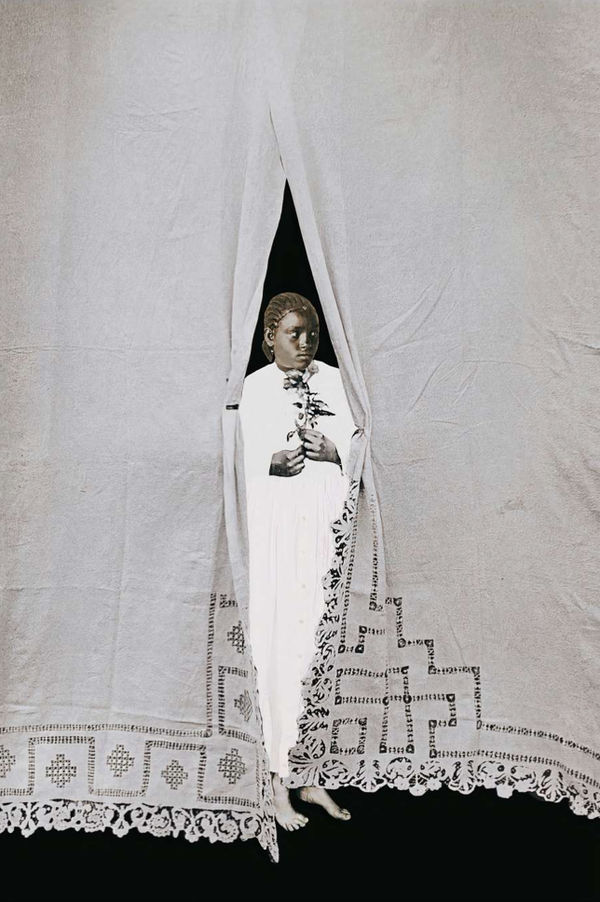
Moropa and Forrester directly engage the representational with images of imagined and mythologized figures that occupy unexpected terrain alongside familiar domestic settings. Drawing on photographic archives and folktales, Moropa explores themes of belonging - using the process of collage to subtly juxtapose the uncanny against the ordinary as a way to narrativize her family history. For Forrester, the narrative is reexamined and rewritten through a Black feminist and queer lens. She engages the Western art historical canon, working against a long and tainted history of representation of black bodies by painting scenes of leisure and pleasure.
Wolf draws on the cultural practices of Southern African women who used to paint their homes with symbols and marks. In her paintings, the figure is liminal and abstracted - rendered in acrylic and sand, that most elemental and enduring material - as a means to draw connections between African spirituality and scientific methods of art-making and building. This exploration of material culture is woven through in Davids’ intricate assemblages bound to the trades of the Cape Muslim community. Using textiles, upholstery and needlework, Davids makes tangible the complex histories of identity, taking inspiration from the lineage of seamstresses and dressmakers in her family.
Part II
Kuba Freter, Boschēr Theodor, Marco Zumbé
Freter’s atmospheric photographic images capture the beauty of the everyday. He is drawn to the syntax of transience, be it subjects captured in motion or movement as suggested by his own process of making, which involves walking and patiently waiting. His work teases at parallels and tensions — between solitude and belonging, fluidity and restraint, ambiguity and clarity.
Similarly, Theodor explores movement and, in particular, its relationship to stillness and stasis. His produced images vacillate between the stopped time of painting and the shifting temporality of film. Decidedly punk with a DIY ethic, his practice merges mediums that are often read as oppositional. For instance, 35-16 mm film, 3D-prints, canvas and acrylic coalesce through experimentation to destabilize frames that we understand particular mediums to hold.
Zumbé, on the other hand, uses domestic scenes and lay objects to suggest how the familiar can be rendered strange, and how the strange can become pedestrian. Through exaggeration, compression and displacement, rendered through the medium of paint and ceramics, he offers new registers through which to encounter the ordinary.
In Alongside, artworks that are self-contained objects - complete with histories, characteristics and sensibilities - point us to interesting dialogues through lines of relation. That is to say, how objects, people and contexts connect and exist alongside each other.
-
Part One
-
-
-
-
-
PART TWO
-
-
-