Sahlah Davids (b. 1998) is a Cape Town-based visual artist whose practice centers on textiles and beadwork.
In her studio practice, Sahlah Davids uses a material language of textiles, upholstery, and needleworking to explore the oral histories of her heritage and strong affiliation to the realm of religiopolitics. Cape Town born and raised, Davids has described her methods of creation as the product of the blended learning and trades of the Cape Muslim community, specifically the elders within her family. It is within the domestic, traditional, and religious spaces that Sahlah draws on the skills of her lineage, the history of their struggles, and, ultimately, the embodiment of their spirituality.
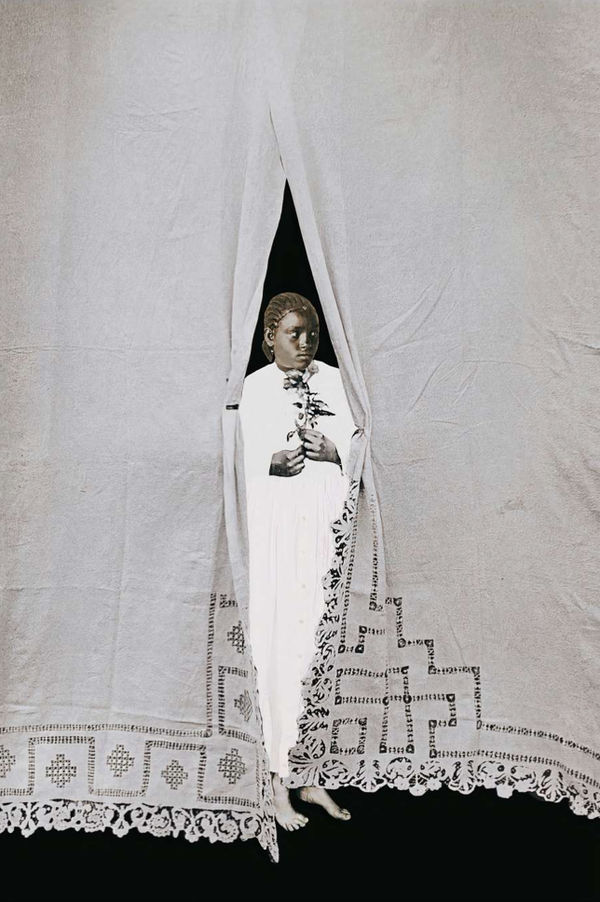
Tshepiso Moropa (b. 1995) is a self-taught collage artist based in Johannesburg, South Africa. With an academic background in Psychology, Linguistics, and Research, her artistic practice engages deeply withAfrican historical archives and oral histories.
Moropa’s work begins in fragments: archival images, memories, folktales, and dreams, which she assembles into hand-crafted collages that feel at once ancient and futuristic, personal and collective. Working across both digital and analogue forms, she constructs visual narratives that reimagine the archive not as a fixed record but as a living and evolving space of possibility. Rooted in the oral traditions of her childhood, her compositions carry the emotional weight of stories passed down through generations, using symbolism, repetition, and abstraction to explore ancestral knowledge, inherited memory, and the dreamlike spaces where these ideas converge.
Miranda Forrester (b. 1997 in London, UK) is a British painter whose practice explores intimacy, identity, embodiment, and the queer Black female gaze. Working primarily through painting, she reimagines the language of life drawing and art history through a queer Black feminist and desiring lens, creating spaces where Black women and non-binary people are represented as expansive, self-possessed subjects.
Forrester’s paintings explore intimacy, connection, and interiority, often depicting figures within domestic and private exterior spaces. Her compositions move between quiet solitude and vibrant communal settings, capturing gestures, glances, and encounters imbued with tenderness, ambiguity, and playfulness. Drawing on visual languages found in cinema, literature, music, and Renaissance painting, Forrester creates scenes in which desire and intimacy unfold slowly and freely. Water is a recurring motif, functioning as a threshold and a site of liberation, where her figures inhabit their bodies and surroundings with ease.
Lulama Wolf (b. 1993) is a visual artist who lives and works in Johannesburg, South Africa.
At the intersection of Neo-Expressionism and Modern African Art, Wolf explores the pre-colonial African experience through a contemporary lens. Her process involves smearing, scraping, and employing deep pigment techniques inspired by vernacular architecture. These techniques often incorporate patterns traditionally created by women to decorate traditional African homes.
History and the proof of life are the core concepts in her work. Where there has rarely prior been reference of life in black spirituality, she counters that narrative by creating two dimensional paintings to embody the simplicity and deep spiritual power of the native eye. Her motivation is both tender and protective of her imaginary world, and her symbolic view of how her world looks into an alternate universe. She is set on creating both a photographic and graphic experience, that morphs and shapeshifts into a higher dimensional plane.
Marco Zumbé (b. 1975) is a visual artist based in Cologne, Germany. He studied Illustration and Painting at the University of Applied Sciences Hamburg under Prof. Rüdiger Stoye from 2000 to 2008. His practice spans painting, installation, and ceramic-based object-making, grounded in a nuanced interrogation of abstraction, perception, and memory.
Zumbé’s work explores the interplay between surface and structure, interior and exterior, through a language of condensed and reconfigured patterns drawn from domestic ornamentation: wallpaper, decoration, and interior design catalogues. His images oscillate between abstraction and narrative, between psychic space and lived environment. In doing so, he foregrounds the act of seeing as a subjective and fragmented experience, marked by projection, association, and distortion.
Boscher Theodor (b. 1967) is a German artist based in Cologne whose practice merges the languages of painting and film to explore the thresholds between stasis and movement, image and time. Growing up in Cologne, then the booming art capital of the 1980s, Theodor was deeply shaped by the punk ethos and the aesthetics of “bad painting.” Early collaborations with Walter Dahn and Imi Knoebel left a lasting imprint on his artistic sensibility, informing a practice that is both experimental and transdisciplinary.
With a background in philosophy from the University of Cologne, Theodor’s work probes the dialectical tensions between the painter’s hand and the camera’s eye, situating itself at the intersection where cinematic temporality collapses into the stillness of the painted image. His oeuvre often inhabits a hybrid field, collapsing distinctions between media while generating poetic encounters with duration, gesture, and perception.
Kuba Freter (b. 1995) is a Polish visual artist who lives and works in Cologne, Germany.
Freter is a self-taught analog photographer inspired by the emotional weight of fleeting moments, the tension between solitude and belonging, and the subtle choreography of everyday life. His work reveals a quiet sensitivity to light, texture, and form - grounded in observation, yet deeply attuned to atmosphere and memory. Contemporary in his poetic restraint, his practice is rooted in walking, waiting, and witnessing - allowing the world to unfold without force. Through his use of analog processes, he constructs images that invite ambiguity and reflection, rendering the transient with clarity and care.